For the last 4 months, interest rates have been on the rise. Beginning with tax reform in December, the markets have anticipated higher inflation, stock prices, and ultimately mortgage rates. Furthermore, the number of homes for sale in most areas have been increasing as well. In the Sacramento area, March saw a 21.7% increase in the number of homes for sale compared to the same month a year ago.For the last several years, most market experts have been saying home values will keep rising until interest rates and inventory rise. Now that the latter has begun, it would make sense that home values may begin to fall, right?
For the last several years, most market experts have been saying home values will keep rising until interest rates and inventory rise. Now that the latter has begun, it would make sense that home values may begin to fall, right?
Not so fast. While rising interest rates and inventory are putting downward pressure on home values, there are stronger pressures pushing them up. The most significant relate to building new homes.
Simply put, California is not building enough new homes (check this article out). Compared to the peak in 2005 when California builders erected 150,000 new single-family homes, 2017 saw 58,000 new units built. This is a significant increasecompared to prior years, but still not enough to keep up with California population and housing demand.
One reason builders may not be building at the pace necessary is the cost to construct new homes (watch this CNBC video released shortly after the metal tariffs were imposed by the US government in March). From lumber and metals to labor and regulation, nearly all costs associated with construction have seen significant increases. These additional costs are anticipated to be passed onto buyers of new homes, which in turn keeps prices higher of resale homes as well. Other builders may decide to not build at all, or build larger homes rather than starter homes that tend to have thinner margins.
The stats support there is no home-price slow-down in sight. The average sales price in Sacramento just reached over $400K, a 5%+ increase just since the beginning of the year. Anticipate home prices continuing their march upward in spite of higher interest rates and inventory. The march won’t last forever, but there are no signs of it stopping any time soon.
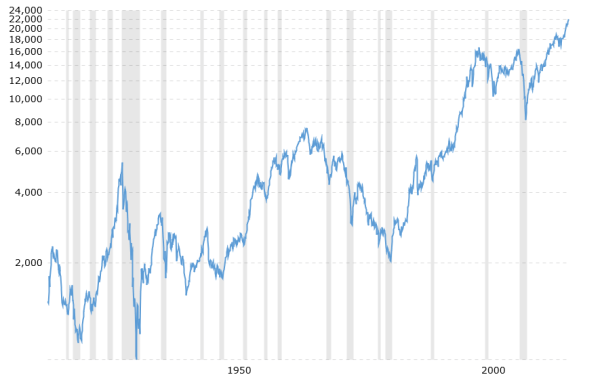
I’ve spoken to a number of clients recently who are nervous about the stock market’s near-term future. It’s been on a rally for nearly 8 years, the second longest “bull run” in history. With current economic and political uncertainty, many are wondering where to safely invest their money.
Dow Jones Index over past 100 years
The current bull run has seen the Dow Jones index rise over 250% since early 2009.
Last month I posted about investing in real estate. Some folks, however, have no interest in owning more real estate. For those in that camp, may I suggest “Earning By Saving.” In other words, by paying down debt you can earn a guaranteed rate of return that compounds over time. After all, a penny saved is a penny earned!
The best way to do this is by refinancing to a shorter term loan, such as a 15-yr fixed mortgage. Lenders offer lower rates if you select a shorter payback term, so while someone may have obtained a great rate on a 30-year fixed loan a few years ago, today’s 15-yr rates are even better!
Here’s an example: a client obtained a $300,000 30-yr fixed mortgage at 4% back in 2014. Their loan balance is now down to ~$283,000. Refinancing to a new 30-yr mortgage doesn’t make any sense, as current rates aren’t much better than their 4% rate. But, when looking at a 15-yr fixed refinance, the new rate would be 3.25% (APR 3.33%). The monthly payment increases by $570 due to the shorter payoff period, but thousands of dollars are saved each year in interest cost. Over the 15-yr period, $62,000 will be saved in interest costs and the home will be paid off completely!
If you find yourself in a position where you can invest more money every month but won’t or can’t put it in stocks or real estate, I would strongly encourage you to look into refinancing into a shorter term mortgage. As Albert Einstein famously said, “compound interest is the strongest force in the universe.” Its mighty power works when you invest, and works just the same when you pay down debt.
I’ve previously written about my love for the game of Monopoly. Ever since I have been old enough to count, its been one of my favorite games. Whenever my buddies and I played I wanted to be both the banker and the property card-keeper; an ironic foreshadowing of my career as a combined mortgage broker and REALTOR. As it turns out, I’ve been playing banker and property card-keeper my entire life!
Love for Monopoly is hereditary
I was playing Monopoly Jr. with my son this week, and it reminded me of this 2011 blog post. Back then, I was helping a few brave clients purchase investment properties despite the bleak economic outlook. Things worked out quite well for that group of investors, as their investments have doubled in value over the last 5 years.
This summer, half of my team’s home buying clients were investors as expectations of Sacramento home prices are high. Combined with low levels of new home building, a flood of Bay Area money (check this article out) and some of the country’s fastest rising rental rates, Sacramento is an area many investors have honed in on.
Clients with the courage to own rental properties over the long-term amass great wealth as home prices rise, particularly in hot spot markets like Sacramento. My team has become experienced in helping clients make the leap to real estate investor. From hosting info seminars (remember this one!!??) to illustrating cash-flow analysis to having trustworthy connections with property managers and licensed contractors, we are a valuable resource to those looking to play real-life Monopoly.
As I said earlier, I’ve been doing this my entire life!
This week marks the 1-year anniversary of the passing of our dear friend, Spencer Rubin. Many of my clients know Spencer. Some of you I wouldn’t have the privilege of knowing without him. In fact, several clients I’m actively working with right now are relationships I made because of him.
To say Spencer had an impact on my life and business would be an understatement. Not simply because he introduced me to some of my clients. Moreover, he taught me how to conduct myself in business; with transparency and authenticity. He befriended both Lisa Ferro and myself when the three of us began as colleagues 16 years ago; a friendship Spencer helped pave the way to a partnership and ultimately the start of The Blue Waters Group. Even the very name of our company exudes Spencer’s ethos; he was always drawn to and at his best on the water.
When you lose someone who beautifully wove his way into many parts of your life, it’s hard to compartmentalize the emotions. We worked, started families, and boated alongside one another, so his absence is felt in many ways. At the same time, however, his presence is felt ever more. This week I saw many social media tributes to Spencer from his dearest friends. Many of them referenced how they are still encouraged by him to live in gratitude, see the beauty, and learn patience (all Spencer colloquiums). In short, his spirit and his beautiful surviving family lives on as wonderful inspiration.
The most inspiring thing Spencer has taught me since his passing is this: no matter how much your time is cut short here on Earth, if you live right you’ll make an impact far beyond your time. We don’t necessarily need to leave a legacy; rather a simple lasting imprint on those we leave behind. An imprint that says I love you, I’m proud of you, and I want only the best for you. That’s what Spencer did for me, and it will continue to inspire me for many years to come.
May seems to always be the most hectic month of the year. Weddings, picnics, school parties, swim team, boating…commitments and fun keep us busy all month long, and I’m sure the same is true for you.
The real estate market has a way of hitting its full stride in May as well. For the last few years, May has signaled the time when many homeowners decide to put their homes on the market. This year appears to be similar as I’ve already spoken to several clients in the first few days of this month. This is a good sign for the market at large since the single greatest issue we have in our market is too few homes for sale.
At time of this writing, there are only 100 single-family homes for sale in Folsom.
This is an incredibly low amount, considering we are a town of over 70,000 people and 26,000 housing units (according to the US Census in 2010). Over the last few years, beginning in May, we start to see this figure increase through the summer months, but since 2014 we have seen the number of homes for sale in the summertime decrease each year.
What will this summer bring? Unfortunately, much of the same. Unless I get more calls from clients interested in selling their homes this summer, I expect the number of homes for sale to be similar to last summer. This means there won’t be enough homes to meet demand, which will push prices up further. For current homeowners, this is great news. For those looking to buy their first home, this is truly discouraging. Perhaps they’ll be too busy with a hectic May schedule to notice right now, but by the end of summer I predict home values in most areas will increase 2% per month through August. If that pace holds, we may see Folsom home prices eclipse their previous all-time high levels before summer is over.
Much like May’s relentless calendar, higher home prices are on their way. Some of the cause is inevitable, like wedding invites in May, and some of our own doing, like over-scheduling boating picnics. Either way…Bring. It. On.
We have all been warned of the three taboo conversation topics: sex, religion, and politics. Touching on such subjects with others often leads to conflict or misunderstanding. Wikipedia even admits on their web site that “its nearly impossible to provide a neutral point of view” on these matters. And yet, NOT discussing politics in our current climate is nearly impossible as well, even for a guy like me who wants to focus on economics rather than politics.
All of these “us” vs. “them” antics are exhausting, and dangerous.
So here it goes; my bold attempt to lace politics into my Part-Professional, Part-Personal, Rarely-Ever-Political blog.
Political news is everywhere! Its even prevalent on financial (see below), fashion (peek at GQ’s polarizing Facebook video page) and sports (Google “Ass or Asset”) news sources .
Check out this screen shot I took last night when visiting www.Money.CNN.com, my preferred source of financial and market news. Every single one of the top 10 headline stories covers some element of President Trump’s administration; they even have a page titled “Trumponomics.” The unavoidable reality is that our politics are shaping our economics, including mortgage rates.
As I’ve been preparing my Annual Market Forecast post (coming soon!), I’ve realized I must understand our political affairs in order to best counsel my clients about the recent and potential future changes in interest rates. For example, mortgage rates and other financial markets have been incredibly volatile since Election Day due to the foreshadowing of how our world may be different under a Trump Administration. In fact, the term “Trump Effect” has been coined as a reference to the markets being indirectly influenced by President Trump. For example, on good stock market days, you’ll read headlines such as “Dow closes above 20,000 for first time as Trump actions spark rally” and “Trump tax talk lifts Wall Street to record high.” And on down days you’ll see “Will Trump kill the Trump rally?” and “Is Wall Street starting to show Trump regret?”
Like it or not, our economics are closely tied to our politics, and it seems that in the near term market movements will be directly correlated to President Trump’s every move, meeting, tweet, and executive order.
So here is the economic takeaway from this tip-toed political blog post: the more volatility, uncertainty, and controversy surrounding President Trump’s first 100 days in office, then the more likely we will see mortgage rates drop. Markets disfavor uncertainty, and when it comes money flows to safer investments such as bonds and mortgages. On the other end, the more focused he becomes on pushing his domestic promises to cut taxes, deregulate industry, and increase infrastructure spending, then the more likely we will see mortgage rates rise. If you are in the market to purchase or refinance a home in the coming months, then the inescapable political headlines you encounter every day have more impact for you, as the Trump Effect on mortgage rates will surely be at play in the weeks to come.
Last month I posted about how RE/MAX, one of the world’s largest real estate franchises, is beginning to mimic our business model of offering one-stop-shop services with mortgage brokers and real estate agents all under the Re/Max umbrella. Imagine that!?! The little guys like me who offer combined, efficient, and effective services must be doing something right if the big guys are catching on.
How about other features of our services? Do the big brokerages still have other advantages due to volume and brand recognition? For example, some homeowners believe they’ll have a better shot at selling their home faster and for top dollar if they list with a big brokerage since they have huge advertising campaigns and a broader marketing reach. Is that true?
Do little guys like me even have a fighting chance in providing superior service and results compared to the Goliaths of our industry?
Let’s look at the stats, shall we! Since 2014, the median days on market for my listings was 9 days and the median sales price to list price percentage was 100%. This means that, on average, I sell your home in a little over a week and for the price for which you list. Additionally, I didn’t have a single canceled or withdrawn home listing. In other words, no one backed out of listing their home with me.
How do these figures compare to the big brokerages? By my account, Folsom’s three largest brokerages are Re/Max Gold, Keller Williams, and Coldwell Banker, accounting for a combined 240+ active agents and 2000+ listings over the last 3 years. Here’s how their figures compare to mine on closed listings from 1/1/2014 thru 11/4/2016 (from Metrolist):
Brokerage
Days on Market
Sales Price to List Price Percentage
Expired or Withdrawn Listings (as %)
Matt Sundermier
9
100%
0%
Re/Max Gold – Folsom
13
99.49%
24.9%
Keller Williams -Folsom
13
100%
22.9%
Coldwell Banker – Folsom
16
99.73%
20.5%
As you can see, there is not much difference on how fast and for how much we are selling our listings. Big brokers are not performing any better than me in these regards. And check out the far-right column, which represents the percentage of listings that expire or are withdrawn from MLS. At the big brokerages, 20-25% of listings don’t even end up closing escrow. Say what?!? Imagine meeting with an agent in preparations to sell your home and they say, “I have a 75-80% chance to sell your home.” Doesn’t exactly instill confidence, right?!
As a reminder, these numbers represent the total population of agents within these offices, so surely there are agents who have a better track record than that. Frankly, the individual agent makes a bigger impact on your listing and selling experience than the broker and brand they represent. But the big take home lesson is this: the big-brokerage advantage is a myth.
In order to effectively sell your home, you don’t need a brokerage with nation-wide TV commercials and a household brand name. You need an agent that has three primary traits: market knowledge, industry experience, and the ability to articulate bothof those to you throughout the home selling process.
The next time you’re in the market to sell your home, don’t limit yourself to just the big-brokerages. As these stats and my track record suggest, there is no distinct advantage to you for going big. In fact, I’d make a VERY strong case it’s probably better you go small!
What other features of mortgage and real estate services that vary from big to small operations may be of interest to you? Let me know and I’d be happy to consider discussing your topic on an upcoming blog post. Until then, thanks as always for reading Matts Memos!
I just returned from a trip to Switzerland with my wife and oldest daughter. The weather was incredible, despite the fact January is typically the coldest and wettest month for the Swiss. Our good fortune was quite remarkable and I can’t help but compare our timing with the weather to how many folks feel about timing the real estate market.
The majestic Matterhorn is rarely seen this clearly during winter. We were very lucky!
More and more clients seem to be asking for my prediction on what the upcoming year holds for real estate. The truth is I can’t time the market any more than I can time the weather!
Instead of basing decisions on good fortune from things beyond our control, I’m an advocate for planning and acting based on things we can control. This is true in most walks of life, including real estate. Below are the 3 things I encourage every client to consider before making an important real estate decision.
Plan Ahead
Most people don’t wake up and decide they’re going off to the airport to go on vacation because the weather looks good in a faraway city. Rather, a long trip requires planning. How are you going to get there? What will you do when you get there?
Planning for this trip began in October. We figured out which cities we would visit, how we were going to get to each one, and where we would stay. Furthermore, we have a “team” of people that we need to consult with prior to traveling (colleagues, grandparents, teachers, etc.), and each one’s input is important in figuring out if and how the trip will come together.
The same is true in real estate. You should not wake up one morning and decide to buy or sell a home on a whim or, even worse, because of what some market “expert” is predicting. It takes planning, and a team of people to help you sort it out. Many people take this time of year to do real estate planning so they are ready to act in the spring when market activity picks up.
Focus on Factors You Can Control
Mary and I knew January was a sketchy month to travel to Switzerland. February or March would have been better as the temperatures are generally warmer and there likely is a bigger snow pack to enjoy for skiing. In the end, January was the month where we could pull it off due to our schedule. In the end, it worked out great because we had Spring-time conditions in the dead of winter!
With real estate, I see many people attempt to decide to buy, sell or refinance based on the right timing in the market. I believe this is a recipe for disappointment. The market is unpredictable and there is no way to guarantee the market is going to behave in your favor. Rather, an important real estate decision should be based on questions you can answer: does your family need a larger home? Are you stable in your career? Can you afford a home? Is your health making it difficult to maintain your home? Do current rates make your monthly payment affordable?
Making a move based on these factors means you are doing what’s best for your timing, not the market’s.
Don’t Let The Outcome Be Determined By Factors You CANNOT Control
As much as we enjoyed our fortunate weather, our enjoyment was not going to be impacted by Mother Nature. We packed for cold weather, and had alternative itineraries for gloomy days should they have arisen. Also, this was a rare opportunity for Mary and I to travel with just our oldest daughter (we have two younger children as well). This factor alone meant we were going to have a memorable and unique trip to spend quality time with her, regardless of the weather.
When it comes to buying and selling real estate, it is a dangerous proposition to say that your decision will only be a smart one if the market ends up working in your favor. For example, if you are considering selling your home this spring because you are confident home prices are going to fall later this year, then how will you feel if prices keep going up? Conversely, if you are thinking of buying this year because you’re convinced you’ll be priced out of the market if you keep waiting, then how deflated will you become if prices and/or interest rates fall instead?
The bottom line is this: you and I can’t time the real estate market any better than we can predict the weather. I encourage all of my clients to put less emphasis on what’s going on in the market, and a greater emphasis on what’s going on in YOUR life. In other words, is buying or selling a right time for YOU?
As I said previously, now is a wise time to begin discussing and making plans for a real estate decision later this year. These types of life-changing events don’t formulate over-night. My team and I are here to help you sort out the important and complex decisions ahead. As always, we value your trust in us to navigate you in your real estate affairs.
Jimmy Buffett sarcastically claims in his iconic song “Fruitcakes”, California has it all. “They’ve got riots, fires and mudslides…” so goes the tune.
In addition to these struggles, we also have an extremely high cost of living. Historically, behind only Hawaii, California has the highest median home sales price of any state in the country. While the median home value in the U.S. is approximately $180,000, the Golden State’s median home price in August was nearly three times that at just under $500,000. Non-Californians think we’re crazy to spend that much money on a pile of bricks. Are we?
I guess the answer depends on who you ask. If you ask me, I seriously believe California does have it all! I am thankful my roots are deeply planted here, and that my career entails being both an advisor and ambassador for California home ownership. Nowhere else in the country do you have as many diverse recreational, cultural & culinary experiences just a short drive away than right here in California.
Photo courtesy of my gorgeous (& photographically talented) first-mate, Mary.
I have not left California in over 18 months. Given my family’s track record of travel, that’s a bit of an anomaly. But, during this time, I’ve had a wider array of vacations than in any other point in my life. In just the last year, we have taken road trips to:
Redwood National Forest – Hiking, beach combing, zip lining
South Lake Tahoe – Skiing, snowball fights
Lake Oroville – Tubing, wakeboarding, fishing
Southern California – Disneyland, Malibu beaches
San Francisco – Beach Blanket Babylon, Live Music in Botanical Gardens, sailing
Central Coast – Rugged beauty, abundant wildlife (I saw a Blue Whale!), sea kayaking
California has it all!!!
When I put together this picture collage, it was such a wonderful reminder of the diversity of our state. Does California have its fair share of problems? Certainly! “Riots, fires, and mudslides” are probably just the beginning. But having opportunities to make wonderful memories is not one of them.
Some may consider Californians to be “fruitcakes.” But, when you learn that CA homes have appreciated more than 50% over the last four years (its true!), perhaps it’s the ones that don’t believe in California homeownership who may be the ones out of their minds.
Over the last 5 years, there has been a growing trend of mortgage professionals electing to work for mortgage companies who operate as banks rather than brokers. In fact, to my knowledge, my firm is one of the only new brokerages to emerge in our community since the mortgage meltdown in 2008. Did my decision to start a business on the minority model doom me from the start? Or is our against-the-tide approach in the lending industry exactly what clients want amongst a crowded selection of impersonal, mega-corporate banks?
All sensationalism aside, the difference between a banker and a broker is simple: bankers lend their own money and brokers do not. However, a growing number of “direct mortgage lenders” actually don’t have their own money either, but rather a line of credit from a larger funding source who ultimately buys the loan from them only days after the loan closes. So they’re essentially still more a broker, like myself, than an actual bank. A common misconception is if you go straight to the company who has the cash to lend then you can get a better deal. This is simply not true.
So who offers better rates? Brokers, like myself, tend to work with “wholesale” banks that don’t sell directly to the consumer. As a result, their only marketing expenses are compensating the brokers that deliver them business. “Retail” banks, on the other hand, spend gobs of money advertising and having access to the consumer directly. While they don’t pay brokers in order to acquire business, they have tremendous other overhead expenses for which to account. I often wonder how much it costs the country’s 4 largest banks to operate their 20,000 retail branch offices! The rates we offer at Blue Waters are very competitive, and most cases lower, when you compare them to other mortgage outfits. Case in point, I recently received a referral from a VP of a large bank to help his brother refinance. I asked him why he would refer it to me instead of the company who signs his paycheck. He said, “your rates are way better than ours. I’m looking out for my little bro.”
And who offers better loan program options? One often assumes that if a bank lends their own money, they get to make their own underwriting rules. While this is true in very few instances with jumbo and sub-prime loans, the more common reality is banks and brokers alike are ultimately originating loans that are sold to investors (ie-Fannie Mae, Freddie Mac, FHA, etc.). As such, we are all following the same guideline rules when working to get your loan approved. Furthermore, a bank has their single menu of loan rates and options. A broker has a multitude of different banks they do business with, so my array of options is unparalleled when comparing to a traditional bank.
The rates and programs of brokers and bankers are certainly characteristics a consumer should consider, but in the end it’s the service level that matters most in your mortgage professional. I can’t universally say brokers have better service than banks, but I can say this: I am completely dependent on my client’s satisfaction of and trust in my company in order to stay in business. I’m not so sure a multi-national, diversified, conglomerate, too-big-to-fail bank has the same mentality. To me, service is more than simply doing what the client asks; it’s about educating and empowering clients to help them make sound financial decisions for themselves.
In our firm, building trust is not done with a formulated diagram. It simply comes down to just doing the right thing for our clients. Every. Single. Time
In many regards, my work is similar to that of a teacher. It is no coincidence that I recently had the opportunity to spend a Spring Semester as an adjunct professor at Folsom Lake College teaching Real Estate Principles. Doing so was a fantastic opportunity to give back to my small community, and also a reinforcement of my desire to teach students and clients alike.
So when choosing your financial professionals I hope that you will keep Dave Ramsey’s (America’s most well-recognized and respected finance commentator) advice in mind, “when getting help with money, you should always look for someone with the heart of a teacher, not the heart of a salesman.”




 If you find yourself in a position where you can invest more money every month but won’t or can’t put it in stocks or real estate, I would strongly encourage you to look into refinancing into a shorter term mortgage. As Albert Einstein famously said, “compound interest is the strongest force in the universe.” Its mighty power works when you invest, and works just the same when you pay down debt.
 Love for Monopoly is hereditary
 I was playing Monopoly Jr. with my son this week, and it reminded me of
  Clients with the courage to own rental properties over the long-term amass great wealth as home prices rise, particularly in hot spot markets like Sacramento. My team has become experienced in helping clients make the leap to real estate investor. From hosting info seminars (
 This week marks the 1-year anniversary of the passing of our dear friend, Spencer Rubin. Many of my clients know Spencer. Some of you I wouldn’t have the privilege of knowing without him. In fact, several clients I’m actively working with right now are relationships I made because of him.


 This is an incredibly low amount, considering we are a town of over 70,000 people and 26,000 housing units (









 Matt Sundermier's Memos on Real Estate & on Life