Award Winning Professional Matt Sundermier Gives His 2013 Real Estate Market Forecast

My real estate market forecasts are the most widely read articles on MattsMemos.com.  Their popularity is certainly not due to profound accuracy; in fact, I’m probably wrong more than I’m right.  Nevertheless, it’s been fun for me to take my best-guess and, as it turns out, it’s been fun for my followers to read.  You can read prior year’s forecasts here, here, and here.  But, you’ll get more from reading the one below which also includes home refinancing, buying, and selling tips.  If you like it, share it!  If you disagree with my projections, make a comment…I’d love to hear your thoughts on our CRAZY real estate market.

Refinancing

Everyone (including me) predicted mortgage rates would rise slightly through 2012 as the economy slowly recovered and as the presidential election brought some clarity to the fiscal and political direction of our country.  We were all wrong.  2012 saw lower rates than ever before, largely due to The Fed’s decision to buy mortgages.  When the Fed’s announced they’d steadily purchase billions worth of mortgages until the unemployment rate hits 6.5% (its currently at 7.8%), mortgage rates fell dramatically.  Presently, The Fed is buying $3.7 billion in mortgages every day, yet the industry only originates $2.5 billion daily, essentially meaning mortgages are “selling-out.” Simple economics dictate that regardless of if its a mortgage investment or a bunch of bananas, when a product sells out due to high demand, prices rise (just think of skyrocketing prices in New England right now as there isn’t enough supply to meet the demand of frantic buyers preparing for the blizzard!).  When the prices of mortgages to investors rise, the rates to borrowers fall.  As long as The Fed stays the course on buying every mortgage off the shelf, we will see these low rates remain throughout this year.  Currently, 30-year fixed rates are around 3.75%.  However, economic conditions around the globe are improving, and with brightening economic forecasts both at home (our real estate rebound will do wonders for America’s economic health) and abroad (many believe the worst of Europe’s fiscal woes are behind them), rates should increase from the record lows we saw last year.

More importantly, accessible programs (like the Home Affordable Refinance Program – HARP)  and rising home values (much more on this below) are allowing more folks to refinance as we march through 2013.  According to statisticians much smarter than me, 4 million more Americans are eligible to refinance today compared to last year simply because their home is worth more now.  If you’ve tried to refinance in the past but hit hurdles due to your home’s value, be sure to check back again.

Read these tips if you’re hoping to refinance this year

Home Buying

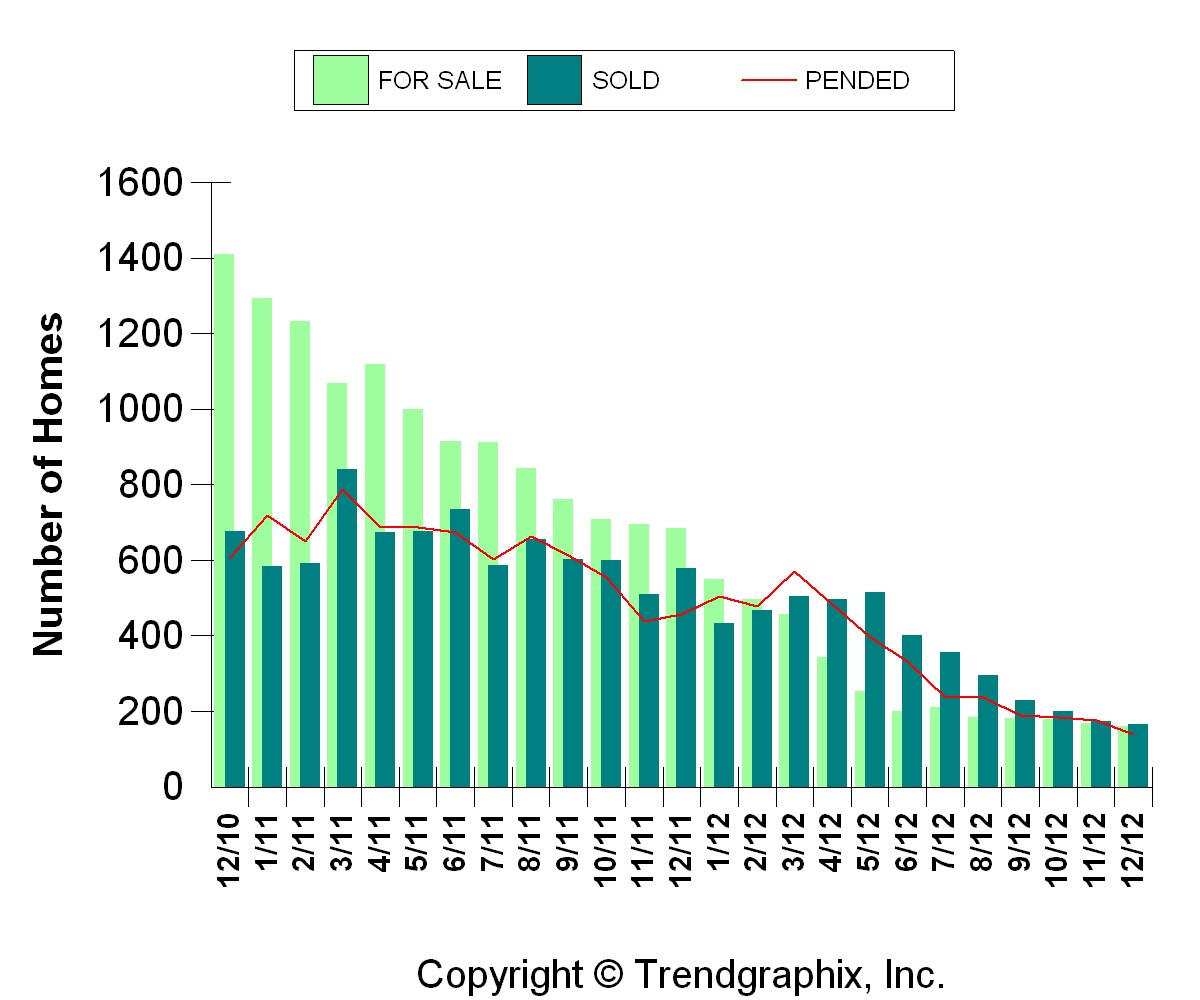
After 6 years of having the negotiating advantage, home buyers last year suddenly found themselves competing over a short-supply of homes for sale.  I foresee this feeding-frenzy dynamic to continue well into 2013…possibly beyond.

The Red Line shows how Sacramento home prices have steadily and dramatically increased

Sacramento County home prices rose 20% in 2012, so many sellers are less inclined to put their homes up for sale if they believe their home will continue to be worth more in the near future.  Furthermore, there’s much pent-up demand from home buyers, including ones who are now eligible to purchase after a short-sale or foreclosure.  Real estate investors also make up a big portion of the home buyer pool as they see big profits in real estate from both a strong rental market and swiftly rising home prices.  In conclusion, the imbalance between strong demand and weak supply should continue this year, leading to further steady price increases for sellers and challenging times for buyers.

If you expect to be a buyer in 2013, here are a few tips:

Home Selling

Home sellers are finally back in the driver’s seat, and likely will remain there through 2013.  Due to rising home values, many once upside-down homeowners are discovering they can now sell and break-even.  “Traditional” sales by sellers with equity now comprise over 60% of home sales, compared to only 34% from just two years ago.  Furthermore, bank-owned sales are down nearly 90% from 2010, thus showing signs banks are foreclosing on and, more importantly, re-selling significantly fewer homes.

These figures show the number of bank-owned REO homes that have hit the market in Sacramento county.

In my opinion, the fear of banks’ “shadow inventory” is grossly exaggerated as many banks are trending to renting out their foreclosed homes or selling homes in bulk to investors who also turn many of the homes to rental properties (this recent Bloomberg article discusses this trend in detail).  Bottom line, 2013 will afford many home owners to sell after years of riding out the market, and to command higher prices than the last neighborhood home sale before them.

Here are a few tips for Home Sellers in 2013

To wrap up, 2013 will see rising home prices, stingy levels of inventory, and slightly elevated interest rates.  It should be a very healthy year for real estate, and likely be the catalyst for economic growth in many other sectors.  The Blue Waters Group is honored to stand alongside you in your home buying, selling, and refinance transactions in the year ahead and beyond.

Final Postcardlong

As always, thank you for reading.

-Matt Sundermier, Mortgage Broker & Real Estate Agent
Owner/Broker of The Blue Waters Group
Two-Year Winner of Five-Star Awards as featured in Sacramento Magazine

Tips for 2013 Refi-ers

Get Tuned in to HARP – The Home Affordable Refinance Program (HARP) allows underwater home owners to refinance.  This wildly popular and successful program is set to expire at the end of 2013.  Despite current efforts from a few senators to extend and expand the program, our strong real estate market (combined the dysfunctional nature of politics) will make it likely 2013 will be the end of HARP.  Find out ASAP if you qualify.  Either give me a call or fill out the short questionnaire at my web site www.UnderwaterRefiCA.com

Find Out Your Home’s Value – For those that don’t qualify for HARP, a refinance loan will require you have at least some equity in your home.  With home prices rising so dramatically last year, many homeowners will now find the opportunity to refinance.  As a combined mortgage broker and real estate agent, I have the added knowledge and insight to estimate your home’s appraised value prior to pursuing a refinance (and paying $450 for an appraisal!!).  Give me a call or select Home Value Request on our web site and I can research your home’s possible value.

A Penny Saved is a Penny Earned – As our population ages (Baby Boomers, I’m talking to you), more and more homeowners are looking to move their investments to safer alternatives than the stock market. If this sounds like you, consider refinancing and paying down your mortgage at the same time.  Doing so will dramatically lower your mortgage payment, thus providing you with lower housing expenses in retirement.  Furthermore, your lump sum investment towards paying down the mortgage essentially gives you a guaranteed rate of return equal to the interest rate on the mortgage.  Try earning a guaranteed 4% rate of return on a CD or other form of safe investment.  Remember, a penny saved is a penny earned!

Tips for 2013 Home Sellers

Now is the Time to Move-Up – If you’ve been hanging on to that smaller house a little longer than planned, now is the time to sell and move-up to the bigger house.  Entry-level homes are in tremendous demand from investors and 1st-timers, while mid-range homes are not moving quite as quickly.  Homes under 1600 square feet went up 23% in Sacramento County last year, compared to 15% for larger homes 1600-2600 square feet.  This allows you to command the highest price possible for your old home, and better chances of scoring a deal on your next house.

Make Demands – This isn’t about greed or bullying, but today’s market enables sellers to be very firm on what terms they accept.  Don’t be bashful about waiving appraisal contingencies, demanding higher deposit amounts, and listing at aggressive prices.

Know the Code (tax code, that is) – The tax rules on short-sales are constantly changing.  Due to the fiscal-cliff negotiations at the beginning of 2013, short-sales are still exempt from federal income tax.  However, state legislation made so such extension.  Before you look to short-sale your home, get in touch with a trusted CPA and real estate attorney to know your options and outcomes.

Tips for 2013 Home Buyers

Know What You’re Looking For – You have to shop for a home with laser-focus, and act decisively when you see what you want.  Don’t window shop for too long; homes are often selling within days to above-asking-price offers. Make a list of features and amenities you’re looking for, and when you see the right house get in there and make a strong offer.

Be Prepared to Pay Market Value (if not more!) – The days of simply looking for a good deal are over.  Sellers have the luxury of being picky in today’s market (more on this later), so “low-ball” offers are easily ignored.  In 2012, Sacramento area home prices rose an average of nearly 2% per month (WOW!), so even if you end up paying a few thousand dollars above-asking price its likely these rising values will aid you to recoup that in no-time.

Credit Wounds Heal Faster Than You Think – Most folks are eligible to re-purchase a home after just 3 years since a short-sale or foreclosure, or 4 years since a bankruptcy.  All you need is a 3.5% down payment and a good credit history since your last mishap.  If you’re considering getting back in the real estate game, obtain a copy of your credit report (we can help with this) to see how your credit past has been reported.

Be Patient & Have Faith – Most clients I work with don’t get the first house they write an offer on.  Some don’t get the 10th house!  But, in hindsight all of them ultimately bought the house they were meant for.  Keep your head up, and have faith that things happen for a reason.

The Blue Waters Group is Expanding & Expecting!

Since opening our doors in early April, The Blue Waters Group has met some major milestones!  Thank you for all of your support, business and referrals that have quickly propelled us from a new start-up to thriving firm.
Our group is expanding, with the newest addition to our group, Donna Adams.  We are elated to have her on board.  Check out our latest video to meet her, as well as get info on my “expecting” news (what could I mean by that?), as well as details about an extra charity drive that we’re kicking off on Halloween (costumes included).
Thanks as always for your support!

http://youtu.be/Nx9qzVQQ2Vo

Announcing THE BLUE WATERS WORKSHOP

The Blue Waters Group is hosting a special & unique event on Wednesday July 25th, 2012.  Check out the video for full details, but in short we’re going to give you great insight on real estate investing in today’s market and afterwards we’re heading out for an afternoon on the water!  Should be a fantastic time.

BIG NEWS!! I’ve Started My Own Company


It is with tremendous excitement I share with you the launch of my own mortgage and real estate firm, Blue Waters Mortgage and Real Estate Group. After 10 wonderful years at Bentley, it is now time to serve you from my own company. I will miss my colleagues at Bentley, and am grateful for their support, dedication, and friendship over the last decade.

Our new firm, as the name implies, will take a “Group” approach in helping you through your home buying, selling, and refinancing transactions. Lisa Parks Ferro, my business partner and fellow mortgage consultant, will support me during absences and also help set the vision for The Blue Waters Group.  Sara Davis, our talented systems manager and loan processor, will be an invaluable asset to our team’s efficient work flow.  Together we have nearly 40 years of industry experience, so you are in good hands.  I’ll do a video blog post soon so you can get to know them a bit, see our new office (we’re in Folsom), and get a better sense of us as a team.

The Blue Waters Group

The opening of our new business comes at an opportune time as the mortgage and real estate markets are healthier than they’ve been in years. Low home prices and low interest rates are fueling a frenzy of investment property and home purchases. New refinance programs (such as the Home Affordable Refinance Program) are opening the door for millions of underwater homeowners to refinance and slash their monthly mortgage payments (see if you qualify by clicking here). And many folks who lost their homes to foreclosure or short-sale in recent years are becoming eligible to purchase homes again (call or email me to learn about the credit requirements of buying another home after losing one). The future looks bright for those looking to buy or refi…better wear your shades!


Throughout my entire career, my clients have fueled my business growth through their referrals and repeat business, for which I am eternally grateful. I am confident your advocacy and loyalty will be even greater towards my new business. I thank you for your support that has enabled me to reach this point in my career, and look forward to see how far you can propel The Blue Waters Group in the very near future.

Could 30 Year Rates go to 3% or 3.5%?

I read this article this morning on Bloomberg. There are some officials that support further action from The Fed to push mortgage rates even lower. How low can they go? Enjoy the read!

(Bloomberg) — Federal Reserve Chairman Ben S. Bernanke can’t go it alone when it comes to reviving the U.S.housing market.

Fed policy makers, who start a two-day meeting today, are considering buying mortgage-backed securities to push down borrowing costs and help homeowners refinance their debt. That would reduce monthly payments, freeing up cash for other purchases that could spur the economy and reduce unemployment, Fed Governor Daniel Tarullo said Oct. 20.

Such an effort would save homeowners $60 billion to $80 billion a year, or about 0.5 percent of gross domestic product, so long as the Obama administration succeeds in helping homeowners through a stepped-up refinancing aid plan, said Joseph Gagnon, a former Fed economist. Should the program fail, Fed asset-buying would probably provide homeowners less than half its potential savings, said Gagnon, a senior fellow at the Peterson Institute for International Economics inWashington.

“The Achilles’ heel of the Fed’s efforts so far has been that the monetary-policy transmission has not worked as they would like because of, in large part, the inability of consumers to get loans” for homes and other purchases, said Ward McCarthy, chief financial economist at Jefferies & Co. in New York.

Refinancing Program

(The Federal Housing Finance Agency said Oct. 24 it will let qualified homeowners refinance mortgages regardless of how much their houses have dropped in value, expanding terms of the 2009 Home Affordable Refinance Program, which has fallen 80 percent short of the goal of reaching 5 million borrowers. The FHFA estimates the changes will help generate about 900,000 refinanced loans by the end of 2013. If the alterations to the so-called HARP plan don’t spur refinancing, any Fed purchases of mortgage bonds would bring limited benefits, said McCarthy, a former Fed researcher.

(The Federal Open Market Committee, which has kept its benchmark interest rate near zero since December 2008, plans tomorrow to release a statement and economic projections from governors and regional Fed presidents. Bernanke is scheduled to hold a press conference at 2:15 p.m., his first since June and third since the Fed started the briefings in April.

(Central bank officials may not be ready this week to pull the trigger on more bond-buying because of an increase this year in core inflation, which excludes food and fuel costs, Gagnon said. Once policy makers see slowing price gains for another month or two, “they will then feel empowered, indeed driven,” to restart asset purchases, he said.

‘Top of the List’

(Tarullo, in a speech in New York last month, said additional mortgage-securities purchases should “move back up toward the top of the list of options” because “the aggregate -demand effect should be felt not just in new-home purchases, but also in the added purchasing power of existing homeowners who are able to refinance.” Fed Vice Chairman Janet Yellen said Oct. 21 that a third round of asset purchases “might become appropriate” if the economy’s state warranted additional stimulus.

(“I don’t know how you could embark on a program of buying agency mortgages thinking you’re going to stimulate more refinancing,” said Bryan Whalen, co-head of mortgage bonds at Los Angeles-based TCW Group Inc., which oversees $120 billion in assets. “It’s not a rate issue, it’s a qualification issue.”

(The average rate on a typical 30-year fixed mortgage fell to a record low 3.94 percent in October, from this year’s high of 5.05 percent, before climbing to 4.10 percent last week, according to Freddie Mac survey data. In September, the FOMC voted to reinvest proceeds from maturing housing debt into mortgage-backed securities, switching from Treasuries.

Record Easing

(New York Fed President William C. Dudley said Oct. 24 that removing “impediments” to the transmission of monetary stimulus would make the central bank’s record easing more effective. The FHFA’s plan to make it easier for borrowers with high loan-to-value ratios to refinance is “a step in the right direction,” he said, adding he hoped additional measures would follow.

(Bernanke said in congressional testimony last month that the Fed needs help from other branches of government to aid the economy. “Monetary policy can be a powerful tool, but it is not a panacea for the problems currently faced by theU.S.economy,” he told the Joint Economic Committee Oct. 4.

(Gagnon urged the central bank to target a 30-year mortgage rate of 3 percent to 3.5 percent by buying as much as $2 trillion of mortgage-backed securities. While boosting stocks and supporting property prices, Fed asset purchases may help create at least 3 million jobs, he said in an Oct. 24 blog titled “The Last Bullet.”

Out of Reach

(“The Fed could do stuff, and it would help, but there would be a lot of people who without HARP couldn’t take advantage of it,” Gagnon said in a telephone interview.

(Reduced home prices and tightened lending standards have slowed the pace of replacement home loans. The Mortgage Bankers Association forecast on Oct. 11 that refinancing this year would total $783 billion, down from $1.1 trillion last year, even amid lower interest rates. Refinancing peaked at a record $2.5 trillion in 2003.

(Stanford University Professor John Taylor, best known for the Taylor Rule formula that suggests how the Fed should set its benchmark interest rate, said more Fed purchases of mortgage bonds are unlikely to reduce loan rates.

(Another round of purchases wouldn’t cut rates “appreciably, and not really in any predictable way,” Taylor, an economic adviser to House Republican lawmakers, said in a phone interview.

‘Difficult to Detect’

(Taylor and one of his graduate students, Johannes Stroebel, wrote a paper arguing that “it is difficult to detect a significant effect” from Fed purchases of mortgage bonds totaling $1.25 trillion from January 2009 to March 2010.

(Gagnon, co-author of a Fed study that found the bond buying lowered borrowing costs and helped the economy, disputed Stroebel andTaylor’s findings, saying they focused on the impact of the actual purchases, rather than the announcement.

(A May 2011 Bank of Canada review of research into central bank bond-buying said the Fed’s MBS purchases “appear to have eased mortgage-market conditions.” At the same time, the Fed’s $600 billion, second round of bond purchases, undertaken from November 2010 through June of this year, probably had a “more modest” effect because of fewer “distortions” in financial markets and the economy at the time, the Canadian central bank’s researchers said.

(Without the administration program sparking more refinancing, Fed asset purchases won’t be of much help to the housing market, says Stephen Stanley, chief economist at Pierpont Securities LLC inStamford,Connecticut, who opposes further bond-buying.

(“If the pipeline is stuck, then it doesn’t matter if mortgage rates are 4 percent, 3.5 percent or zero,” said Stanley, a former Richmond Fed researcher.

Average Investments Yield Amazing Returns

Below is a sample of home prices, rent rates, and rate of returns in various areas of Sacramento County for an averaged-sized 3 bed, 2 bath home. As you can see, just the AVERAGE numbers are very attractive. And these return rates don’t even factor in loan balance reduction or home value appreciation! Tell me, are your other investments giving you this type of return? Are they as safe and tangible as real estate?


Avg. Sales Price (as of June ’11)

Avg. Rent Income

Estimated. Expenses*

Annual Rate of Return**

Folsom

$265,000

$1,719

$1,253.85

7.83%

Rancho Cordova

$153,000

$1,357

$766.19

16.39%

Natomas

$153,000

$1,432

$766.19

18.47%

Arden

$193,000

$1,409

940.35

10.56%

O-vale/
C. Heights

$173,000

$1,352

$853.27

12.40%

Carmichael/
Fair Oaks

$211,000

$1,469

$1,018.73

9.36%

*expenses include mortgage interest, property taxes, insurance & city/county utilities

**based on a 25% down payment and $5000 in immediate closing costs/repairs

Purchasing rental properties requires a much more analytical approach than traditional home buying.  With my expertise in both the financial and sales aspects of real estate, I am well-prepared to help you become a successful real estate investor.  And remember, using a Realtor to buy a home doesn’t cost you anything…the seller pays the commission.  So don’t do it alone; ask me to be of service in this advantageous real estate market.  

Renters See Prices Skyrocket

As home prices have fallen to levels not seen in nearly a decade, rent prices have been on the rise due to rising demand for rental housing and the lack of new unit construction. According to HotPads.com, national home rental rates are up 6.7% from just a year ago. What does this mean for a real estate investor? It means you can buy homes at low prices and rent them for good money. Click here to read full article from SmartMoney Blogs.