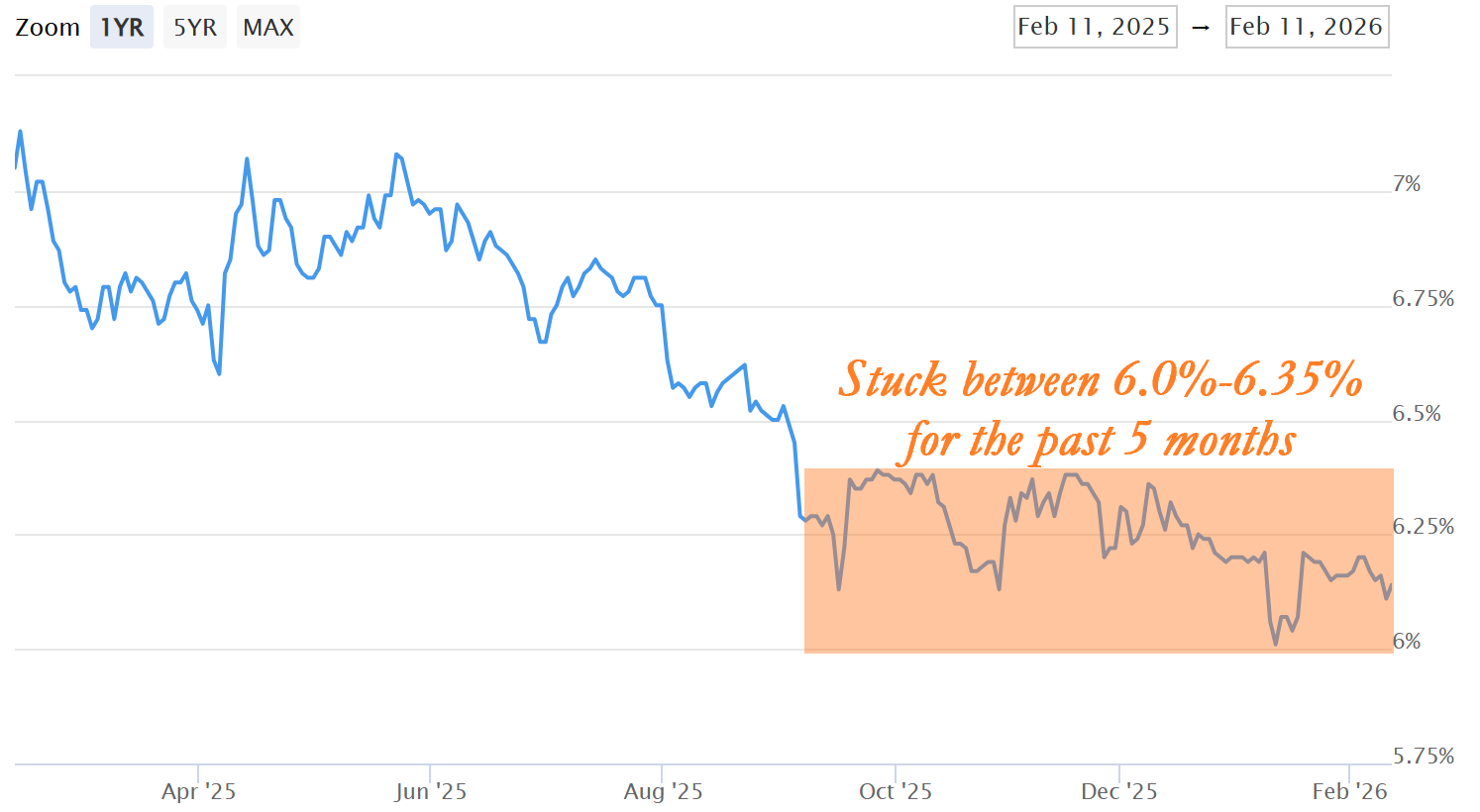
After several years of sharp increases and unpredictable swings, mortgage rates have finally entered a period of relative stability. While rates remain higher than the historic lows of 2020–2021, the consistency we’re seeing in recent months is creating something the market has been missing: confidence.
30-yr chart from Mortgage News Daily
So what does this mean if you’re thinking about buying or selling?
Stability Brings Predictability
When mortgage rates move dramatically, buyers tend to pause. Rapid changes create uncertainty about monthly payments, purchasing power, and timing.
Stable rates, even if they’re not “low,” allow buyers to:
Calculate payments with confidence
Plan financially without fear of sudden spikes
Move forward without constantly trying to “time the market”
In other words, stability reduces hesitation.
It Could Always Be Worse
Given the incredible volatility in financial markets over the past year, we should be thanking our lucky stars that rates are as low as they are. Stubborn inflation, low unemployment rates, stock market rallies, tariff wars, record government debt levels, international conflicts, and domestic unrest have consumed headlines over the past year. These are all factors that tend to push rates higher. And yet, mortgage rates have fallen 1% during that time. Phew!
Buyers Are Adjusting
The initial shock of rising rates initially experienced in 2022 has worn off. Today’s buyers are adjusting expectations and focusing on:
Long-term value
Negotiation opportunities
Seller concessions
Sellers Benefit from Serious Buyers
Stable rates also filter the market. The buyers actively shopping right now are motivated and realistic. They’ve done the math. They understand today’s financing environment.
For sellers, that means:
Fewer “just looking” showings
More qualified buyers
Stronger negotiations
Less last-minute fallout due to rate swings
Well-priced homes are still moving.
Return to a More Normal Market
For the past 5 months, rates have stayed within a .3% range; the lowest level of volatility seen since 2021. When rates are flat like this, buyers & sellers both begin to accept these rates as the new normal and make more confident decisions.
Bottom Line
Stable mortgage rates may not grab headlines the way dramatic hikes or cuts do, but they bring something even more important: confidence and clarity.
It’s that time of year where one day feels like summer and the next winter. Last week I put away my outdoor furniture, only to want to haul it out just a few days later to enjoy the warm sunshine! And today the forecast was for over an inch of rain and it’s looking like we won’t even get half that. It’s tough to plan with such wild weather swings!
The real estate market is similar at the moment. After an encouraging September where home sales surprisingly increased year-over-year in most parts of the state, October showed disappointing figures. With such inconsistent trends, identifying the vibe of the market is harder than ever. The government shutdown, high cost of living, and unpredictable mortgage rates are all impacting the real estate market in unpredictable ways.
You can read the signs
and still get it wrong!
I have a number of clients hoping to sell their homes in the coming months, and many of them are trying to time the market. They ask me questions like,
“Should I list for sale now before the holidays?”
“Should I wait till Spring?”
“How much more will my home be worth in 2026?”
Just ask me if it’s going to rain on Christmas while you’re at it! In all honesty, timing the market is a lot like timing the weather. You can read the signs, but ultimately its impossible to pull off every time. Here’s a throwback video I shot discussing this analogy.
Even though I’m an expert and live & breath market statistics and trends, I can’t predict the real estate future with any certainty. That’s not what you should expect of me or any real estate professional. What you should expect is help identifying what is most important in your next real estate transaction and navigating through it without losing sight of your priorities. Sellers often get caught up in timing the market that they forget why they are selling in the first place.
I have a client who lives in a home that no longer suits her and the property is bleeding her money in repairs. There are 2 homes that sit on 10 acres and require a lot of upkeep, so this widower recognizes she needs to live in a simpler, low-maintenance home. That is the priority; to change her lifestyle that will improve her health and finances.
But sadly, the quest of maximizing her sales price based on market timing has taken over. And during this quest, she has changed her mind several times, questioned herself, and ultimately is shackled in indecision. All the while, the property expenses are piling up and she loses sleep worrying about what to do. She keeps asking herself “when,” while the most important question she needs to ask herself is “WHY.” Why am I selling my home?
Does this sound familiar to anyone you know? Perhaps your own situation? When toiling over an upcoming home sale, ask me these questions instead:
“What is my home worth right now?”
“Where should I put my focus on improving my home for a sale?”
“Who can help me make this process as easy as possible?”
In short, control your controllables, and most importantly…FIND YOUR WHY. Why are you selling your home? Allow me to help you never lose sight of that.
I’m sure you’ve heard the news…mortgage rates have finally been falling! But if you’re sitting on a high mortgage rate should you hold off on a refinance until after the upcoming Fed press conference?
Many people expect The Federal Reserve to lower the federal funds rate 1/4-1/2% on September 17th. But what most people misunderstand is this has no bearing on when or even if mortgage rates drop. Mortgage rates have already fallen nearly ½% in the past 30 days due to the same market conditions that are prompting The Fed to cut their rate next week. Mortgage rates don’t wait for Fed policy; mortgage rates change in real time as market conditions change.
Here’s my advice…if your mortgage rate is currently at 7% or above and you have good credit and home equity, look into refinancing now. Don’t get greedy and hope rates get even better next week. It’s worth pointing out that the last time The Fed lowered their rate, mortgage rates actually increased. As the old adage goes, better to take the bird in the hand, instead of two in the bush.
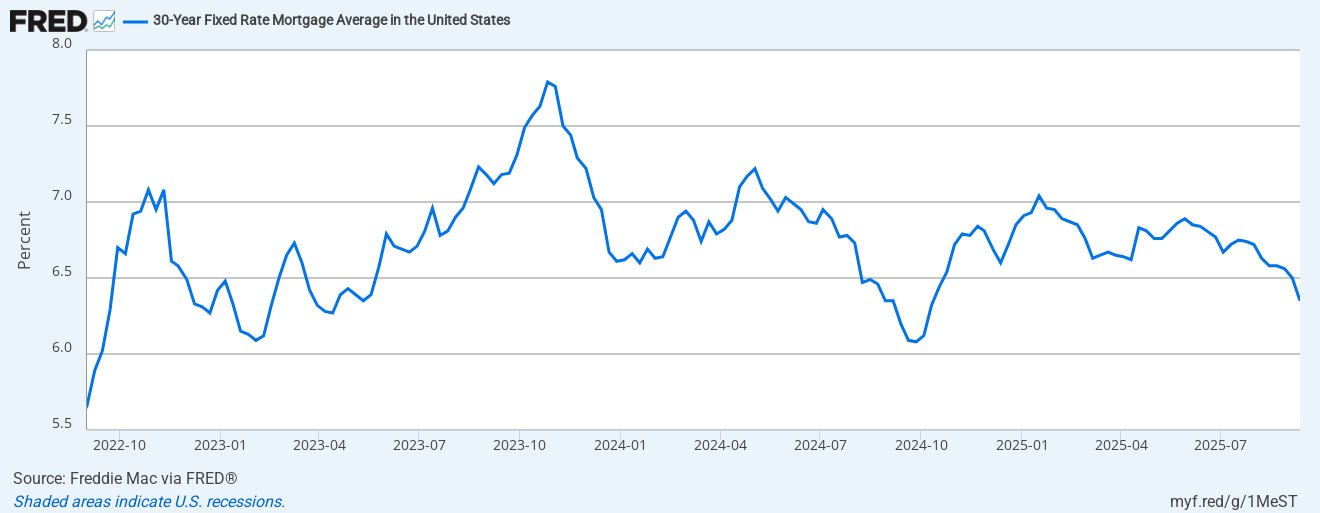
As the chart below illustrates, mortgage rates have not dipped below 6% in the past 3 years. And each time they approach that barrier, they bounce HARD in the other direction, rising 1.0-1.5% in the following months. We are testing that 6.0% barrier again. Will it break through this time? Or get rejected for the third time in three years?
But, if your mortgage rate is already in the 6s and you’re not interested in shortening your term to a 15 yr loan, then “roll the dice.” Sit tight and see if rates fall further. I wouldn’t count on it happening right away, but there’s always that small chance lower rates are on their way.
I’ll be working this weekend and can even lock your refinance rate during after-market hours. Hit me up if you want to explore your refinance options with an experienced & local mortgage broker before the high volatility of next week’s Fed meeting impacts the financial markets.
The world’s financial markets are currently in chaos as a global tariff trade war escalates. For the first time ever, the Dow Jones stock market dropped more than 1500 points two days in a row. The S&P 500 stock market is down more than 20% in recent weeks, a textbook “bear-market” collapse.
Fear, uncertainty, and panic are beginning to set in. Typically, these types of market sentiments lead to lower rates.
Dow Jones stock market free falling!
But contrary to recent sensational headlines and advertisements, mortgage rates have not had a huge slide…yet. Last week, 30-yr rates fell .15% to their lowest levels thus far in 2025. That has spurred a tremendous amount of refinance marketing activity amongst mortgage companies. But the reality is most folks with rates under 7% still won’t realize much benefit from a refi.
Mortgage Rates are improving, but not as much as the media and advertisements may suggest
If things continue, however, there will be tremendous refinance opportunities for many homeowners. As always, I will keep a watch on the financial markets and reach out when I see realistic refinance opportunities for my clients.
If you are hoping to refinance to a lower rate, temper your excitement for now. Don’t fall for the premature hype being pushed by aggressive mortgage marketing companies. But, it would be a great time to begin the application process with me as we await rates to drop further.
Should you call a big bank to get the lowest rate? Nope!
Let’s get real about big banks. Some folks think that they need to go to a big bank like this one to get the best mortgage rate on their next home loan. When in actuality, nothing could be farther from the truth.
Chase Bank, the largest bank in America, has nearly 5,000 branches just like this one all across the country. In 2022 alone, they spent nearly $3 billion in advertising. So think about it…big banks with big expenses like this they need to earn big time interest on the loans that they issue in order to make a profit.
Last month as an example, I had a longtime acquaintance of mine reach out to me because he was in contract by a new house. He’s a big time depositor with Chase Bank so he reached out and got a home loan quote from them thinking that they would give him a smoking deal. Well, I was actually able to find a lender of mine that offered him an interest rate nearly half a percent lower than Chase’s rate saving hundreds of dollars every month on his mortgage payment.
So here’s the deal…as a mortgage broker over the last 20 years I don’t work with big retail banks that spend billions on advertising and rent. Instead I work with reputable wholesale lenders that have much lower overhead expenses and as a result they and I can offer you better rates.
Over the past 15 years, I’ve provided an annual forecast of the mortgage and real estate markets. Generally, I speak to three main characteristics: housing supply, buyer demand, and interest rates.
This year, it’s all about the rates. If 30-yr mortgage rates remain at 7% or higher, housing supply and buyer demand will remain anemic. If they fall below 6%, we will see a flood of both buyers and sellers enter the market. Much of 2023 & 2024 saw rates largely stay within the 6-7% range, which led to generational-low transaction count and record-low affordability levels.
As such, it makes sense to focus my forecast on where interest rates may be heading in 2025.
Who Controls Interest Rates?
Many people are led to believe mortgage rates are controlled by select individuals, such as bank CEOs, The Federal Reserve Board (affectionately known as “The Fed”), or the sitting president (not sure what his affectionate nickname is at the moment). This is not correct!
Mortgage rates are actually controlled by the buyers and sellers of mortgage backed securities. In plainer words, mortgage rates move by investors trading mortgages. There is no man behind the curtain; no key players puppeteering rates, nor a president successfully demanding interest rates “to drop immediately“.
Instead, rates move based on risk & opportunity cost for these free-market investors. Let’s talk briefly about each of these factors.
First off, the biggest risk factor for a mortgage trader is inflation. Inflation eats away at the value of money, so when inflation increases traders don’t want to buy ultra-low rate mortgages. If they buy a mortgage bond with a 3% fixed rate, but inflation is at 4% they are actually losing money.
And opportunity cost is simply a question of can a trader buy an alternative investment with a higher rate of return & lower risk. So, no smart trader would buy a 3% mortgage when there are risk-free money market accounts offering 4% savings rates.
Below are the issues mortgage traders will be focused on in determining how much in mortgages they want to buy and at what interest rates.
Factors in 2025 that will push rates DOWN
Slowing Economy – Many sectors of our global economy have slowed down in recent quarters. Many factors could have contributed to this (political uncertainty, rising cost of goods/services, ), but generally interest rates fall during sluggish economic times. The primary driver of recent Gross Domestic Product (GDP) growth was personal consumption, but I believe personal consumption will slow in 2025 as households are forced to tighten their financial belts. Credit card balances are at record highs and continue to climb (check out my prior post about the alarming levels of household debt).
Lower Inflation – Rising prices on everything took a toll on most of the world in 2022-2023, but things are starting to ease. Inflation rates are now slightly over the historical trend and The Fed’s preferred level of inflation. Don’t expect prices of things to fall, but if they hold at near-constant levels then mortgage rates should decline.
Higher Unemployment – If fewer people are working, it is a sign of a weakening economy. While statistics continue to show 100-200K new jobs being created every month, this could change dramatically in the coming months. The largest employer in the US (the federal government itself) is mandating most employees to return to the office for work and looking to significantly scale back the total number of government employees. This could drastically change the employment picture, and push the unemployment rate up.
Factors in 2025 that will push rates UP
Long-term Tariffs – President Trump is using Executive Orders to impose or threaten tariffs on certain countries and certain products. Tariffs are essentially an added tax on goods that are made in a foreign country. Some people think this added cost will be absorbed by the foreign company who is importing the goods, but this is rarely the case with tariffs. The tariff is typically added to the cost of the item, meaning the end consumer (Americans) will incur these tariff expenses. If tariffs become more of an entrenched part of Trump’s foreign policy rather than a short-term negotiating tactic, it will drive up inflation and interest rates with it.
Smaller Labor Force – Between deportations and baby boomers retiring, the number of available workers could decrease. With fewer workers, employers will need to increase wages to entice people to the workforce. This will fuel the flames of inflation (as it did when we came out of the deepest economic trenches of the pandemic) and push interest rates up higher still.
Growing Government Debt – Our country is in debt more than ever before. Presently, we carry over $30 TRILLION in debt, which is over 120% of our Annual GDP. That percentage is similar to levels seen at the end of World War II. It made sense we were in debt up to our eyeballs after fighting a World War for 4 years, but this is the first time we’ve been at these levels during peacetime! Our government debt is sold to investors via Treasury bonds, and the more we go into debt the more we have to entice them to keep buying our bonds. This enticement is in the form of higher rates of interest earned by the investor (and paid by the borrower). If rates of gov’t bonds increase, then mortgage rates will follow suit as well.
What Will Win The Tug-of-War?
2025 will see these pressures pull against one another, and neither will be a clear-cut winner. I do believe the downward pressures will slightly win out, as some of the upward pressures (tariffs in particular) also tend to slow down an economy, which should lead to lower rates. Overall, if you start hearing the R-word (“recession”) thrown around in 2025, expect 30-year rates to finally dip below 6% by the end of this year.
If mortgage rates do considerably improve, there will be more real estate transactions but not necessarily higher home values. It is expected more homes will come up for sale (both new construction and resale homes), which will keep home values somewhat in check.
If mortgage rates end up increasing above 7%, then we could see home values fall. With affordability already out of reach for so many potential home buyers, worsening conditions will further reduce the already anemic levels of demand currently seen.
Do you have thoughts or insights to share about your local real estate market? Leave them in the comments section below.
Let’s Get Real about Loan Assumptions. With current mortgage rates holding steady at their highest levels in decades, some believe a way to afford their next home purchase is to assume a seller’s existing loan at a much lower interest rate. Sounds like a great life hack, right??!! Why take out a new mortgage at 7% or more when you can assume an old one at 3% or less? While it is true that some loans are assumable, the odds of one being available on a home that you actually like and end up buying are next to zero.
I helped a recent client locate a home in Fair Oaks that was perfect for them. The seller was a veteran; my buyer was a veteran. VA loans are one of the few types of loans out there that are assumable; seemed like a match made in heaven!
But here’s the unfortunate reality…the loan assumption application process is cumbersome and takes time; often 1-2 months. This particular seller wanted a clean, fast sale, so even though the listing promoted the assumable nature of the mortgage, the seller ultimately selected a buyer who could purchase the home without assuming the existing VA loan.
Very few listings will have an assumable loan. And those that do will likely be very popular, and the seller may not be inclined to go through the assumable application process. Sure, I can help you filter home searches based on assumable loans (there’s 14 for sale in all of Sacramento County at the moment & 21 sales in all of 2024), but I wouldn’t recommend hanging all of your homeownership hopes on an assumable loan.
A few short weeks ago, nearly everyone (including me!) was anticipating mortgage rates to move lower. The media hyped up the forecasts. The Fed fanned the flames of these forecasts. I provided analysis to support the forecasts. But the financial markets often have a way of humbling bold predictors.
In early September, 30-yr fixed mortgage rates were hovering just over 6% and flirting to drop into the 5s. Since then, however, rates have aggressively climbed and are now threatening to return to the 7%+ range. DOH!!! It turns out we all were dead wrong.
I have several clients who would have benefitted from a refinance in September. Those lower rates could have saved them hundreds every month, and the closing costs were reasonably low. But many took the gamble of waiting to see if rates would fall further. Their decision to not take “the bird in the hand” has left them wondering how long it may take for rates to settle back down.
That’s why we shouldn’t rely on crystal ball forecasts from anyone (including me!!!) to make decisions. My recent post titled “When Should You Refinance” reminded that we should let numbers decide for us. While I often provide analysis and predictions about the mortgage and real estate markets, I share with clients that timing the market can be a fool’s errand. Do any long-time followers remember this 2016 video post that spoke to market timing?
A refinance transaction is when I see the most clients attempt to time the market, and it’s the transaction that is hardest to pull it off successfully. I advise clients all of the time that timing a refi is just like gambling. There is more emotion than logic at play, and our feelings of wanting/needing a lower interest rate cloud our judgment.
In short, don’t listen to people or their interest rate forecasts. If you have a higher mortgage rate and would like to refinance, follow these three initial steps:
Determine how much lower you’d like your monthly payment to be. Most folks like to see at least $100/month in savings.
Multiply your desired monthly savings amount by 12. In most cases, this total should be your maximum amount you should pay for refinance closing costs.
Work with me to set a target rate that achieves both your monthly savings amount and closing costs limit AND STICK TO THE TARGET! I will monitor & track mortgage rates constantly and advise you when/if we hit your target.
Mortgage rates should eventually settle back down. Take this opportunity to get a plan prepared to act decisively when the next refinance opportunity presents itself.
Here are the factors to consider if you have a rate over 6%
Clients often ask me about “timing the market.” In other words, is there a way to get the best price or lowest rate based on WHEN you buy/sell/refinance? Last year I researched historical data of the past decade and posted about the best times of year to buy and sell homes in Sacramento. It revealed seasonal trends that show Winter (not Summer!) is the best season for sellers and Fall (right now!) is best season for buyers. Even Realtor.com supports my research in their own recent report that claims THIS WEEK (September 29-October 5) will be the best week this year to buy a home!
But how about timing a refinance? Is there a way to perfectly time the financial markets to assure you get the lowest possible mortgage rate on a refi? Let’s dive in and discuss!
As you may know, mortgage rates move every day. Much like stock prices, their daily gyrations are unpredictable even though many market experts spend their lives studying and predicting them. But surely there must be a way to know if mortgage rates will go up or down in the near future, right???
WRONG!!! We only need to look back a couple of weeks for clear proof of the erratic nature of mortgage rates. On September 18th, The Federal Reserve officially lowered the Federal Funds Rate by ½%. Many expected mortgage rates to follow suit, but surprisingly mortgage rates actually increased slightly upon The Fed’s actions.
Mortgage rate changes do not have seasonal trends the same way as the real estate market. To prove this, I studied data of 30-yr mortgage rates from the past 40 years, and found that mortgage rates don’t drop more frequently in one time of year over another. I recorded all of the months where mortgage rates fell, and noticed these tallies were evenly spread out throughout the year:
Season
# of Months w/ rate drops (since 1984)
Spring
73
Summer
52
Fall
76
Winter
77
As you can see, there is no season that significantly stands out above another. In fact, Spring, Fall and Winter had nearly the identical number of months that experienced rate decreases.
As an easy visual comparison between the real estate and mortgage markets, look at the rhythmic, predictable nature of the chart on the left showing home sales over the past 10 years (generally peaks in 2nd quarter; bottoms in 4th quarter) to the chart on the right showing 30-yr mortgage rates over the same time period (no pattern whatsoever).
Real Estate Sales look like a heartbeatMortgage Rates look like a seismograph!
If seasons are not an indicator, then perhaps significant events could be a tell-tale sign for mortgage rate movements…presidential elections, perhaps? Many people believe major elections create uncertainty in the financial markets, and generally mortgage rates fall in times of uncertainty. As a result, I’ve had some clients who could benefit from a refinance today gamble their guaranteed savings of today by holding off on a refinance decision until after this year’s upcoming election. Risky move, especially given the history of what mortgage rates do (or don’t do!!!) in election years.
I looked back at mortgage rates since 1980 and tracked the direction of rates in the months leading up to November. I found that in these 11 presidential cycles, 5 of them experienced rate increases while 6 saw decreases; a mixed bag with no clear trend. Most of these periods saw modest changes, with the average rate change being less than .5% over the 10-month pre-election intervals.
If the sun and moon and stars and elections can’t help us predict interest rates, then what should we look to instead??? Here’s my honest advice…ignore all of the “signs!”
Put away the tarot cards and pick up a calculator! When deciding when or if to refinance, stick to these simple factors:
What will today’s interest rate save me?
What will today’s interest rate cost me?
How long do I plan to have this loan?
Generally speaking, most of my current clients are choosing to refinance if they can recoup the closing costs within 12 months of their monthly savings amount. For example, if a proposed refinance costs $3,000, then it would make sense in most cases to do so if you can save $250/month or more. Doing so is allowing them to save money now, but keep the opportunity to refinance again if rates continue to fall in the future.
While these are straightforward calculations, the pros & cons of a refinance can be nuanced and best talked through with a trusted professional. As mortgage rates have fallen in recent months, aggressive marketing campaigns aimed at pressuring homeowners to refinance have increased dramatically. Don’t let an inexperienced sales call center guide you through an important financial decision; reach out to me to discuss your options.
Many believe mortgage rates are set to drop this week because of a highly anticipated Federal Reserve Board meeting that begins tomorrow. THIS IS WRONG! Mortgage rates are indeed poised to fall, but not because of The Fed meeting. Let me explain…
Last summer I wrote a similarly titled post about a rare phenomenon in the financial markets known as a yield-curve inversion. You can go back and read it (especially if you’re a Top Gun fan), or here are the brief Cliffs Notes…
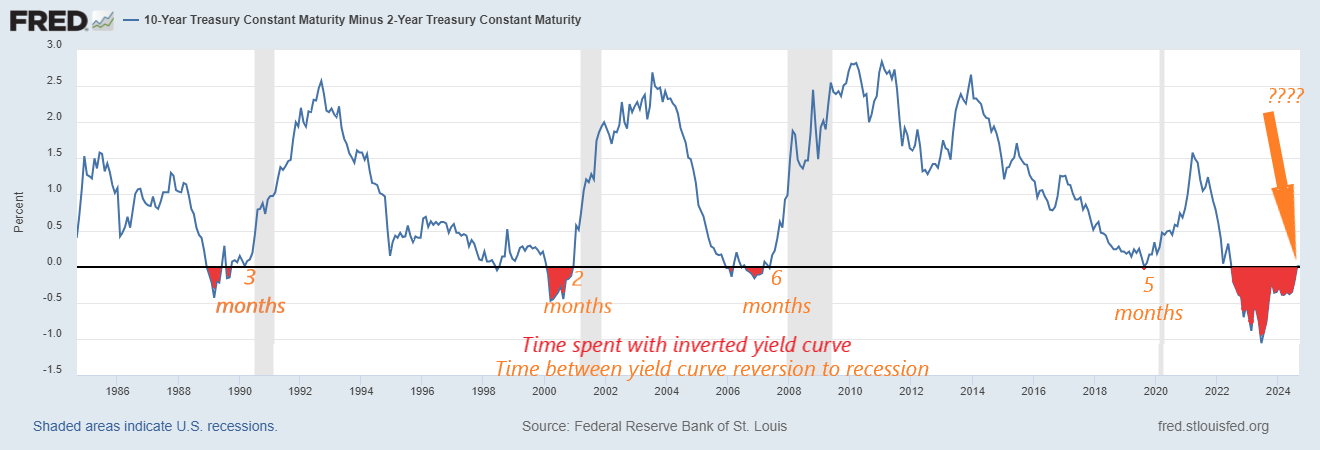
A yield curve inversion occurs when rates on short-term bonds are higher than long-term bonds. An inversion has only occurred 4 times in the last 40 years, and an economic recession has shortly followed each and every time.
Well, I’m here to update you on the yield curve and clarify the timing of the recessions that typically follow.
This month marks the first time in over two years where the yield curve is no longer inverted. It’s the longest continuous inversion period in modern economic times (sections colored in red on chart), and many feel it’s return to positive territory is long over-due.
But, this does not mean we are out of the recession woods. In fact, it’s typically a sign that economic troubles are just about to begin. A yield curve reversion to normalcy has preceded every recession of the past 40 years by just a few short months (2-6 months). If history repeats itself, then its only a matter of when we’ll be in a recession…possibly as early as later this year!
Some argue that we are already in one. Influential & entertaining economist Elliot Eisenberg finds that 9 of the 20 most reliable recession indicators have already been triggered. Historically, when at least 6 of these indicators are flashing red, a recession was already occurring or was about to.
This is not meant to be a doom & gloom post. In fact, quite the opposite!!! The real estate and mortgage markets have been in a funk for the past 2 years, largely due to higher interest rates. The silver lining to an economic recession is it will likely lead to significantly lower mortgage rates. Lower rates will help struggling homeowners consolidate debt more affordably, aspiring home buyers to break into the market, and hesitant home sellers feel less locked-in to their current low-rate mortgage.
All in all, a mild recession and lower mortgage rates could be healthy for our sputtering real estate market. Time will tell if and when lower rates are coming, but if you’ve been holding off on making a big real estate decision due to high interest rates, then you should begin reconsidering your options now. Give me a call to discuss where rates are at, where they may be heading, and what they need to get to in order to help you make a confident decision in your real estate affairs.










 Matt Sundermier's Memos on Real Estate & on Life